


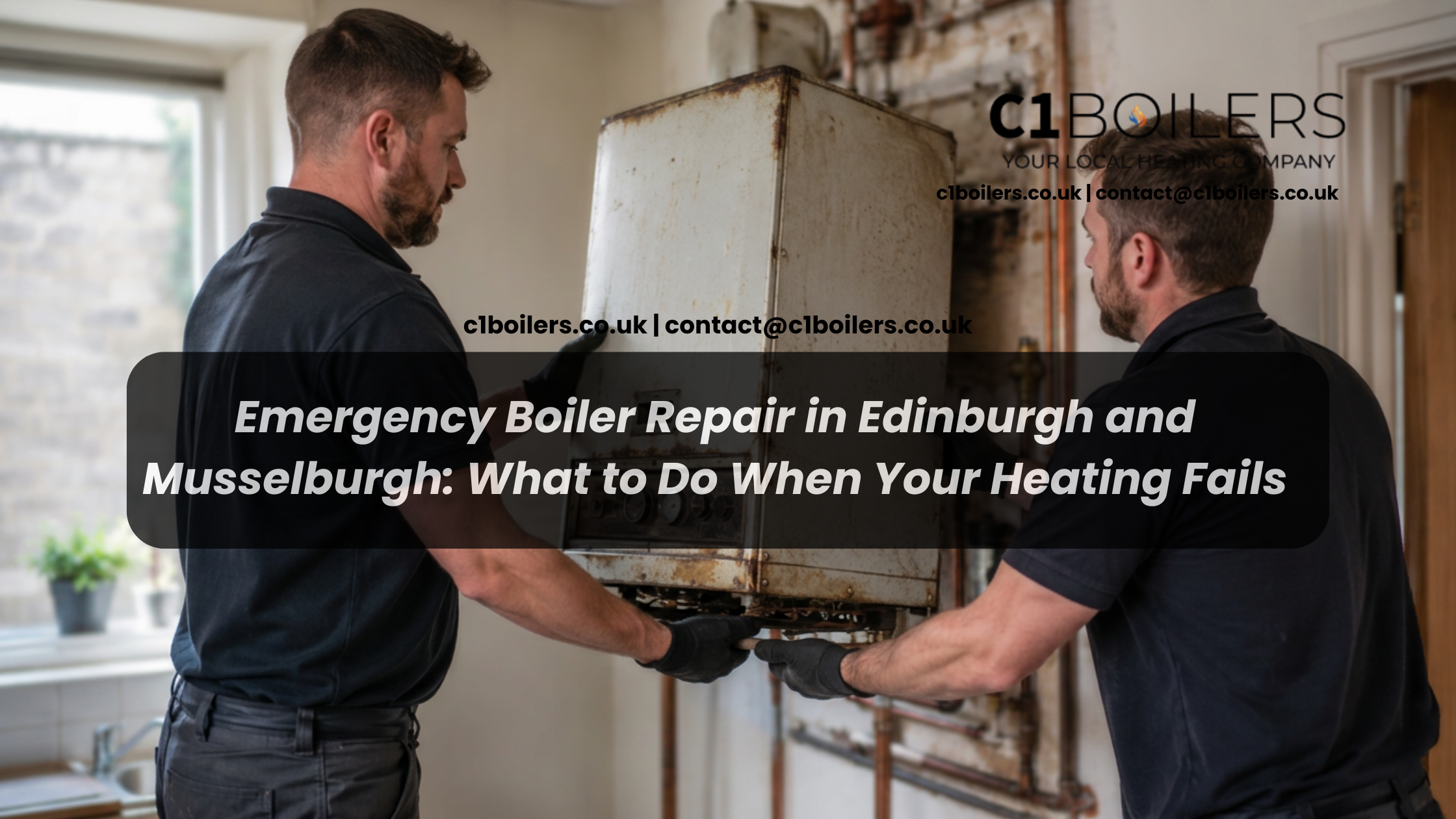
There is a particular kind of stress that comes with a boiler failing on a cold night in Edinburgh.
The heating stops. There is no hot water. The house begins cooling down, and you are left trying to decide whether the problem is dangerous, whether it can wait until morning, and how quickly an engineer can realistically reach you.
Not every boiler fault needs an emergency visit. Some problems can be checked safely at home, while others require you to leave the property and contact the National Gas Emergency Service before you call a boiler engineer.
Here is what genuinely counts as an emergency, what you can check without opening or interfering with the boiler, what an emergency repair may cost, and what a proper fast-response service should look like in Edinburgh and Musselburgh.
First: Is Anyone in Immediate Danger?
Before checking the boiler display or pressure gauge, rule out the situations that could put people or the property at risk.
You Can Smell Gas
A smell of gas is not an ordinary boiler repair.
Do not wait for a local heating engineer to arrive and diagnose it. Call the National Gas Emergency Service immediately on 0800 111 999.
Where it is safe to do so, open doors and windows, turn off the gas supply at the meter, and avoid smoking, naked flames, or operating electrical switches. Do not return to an unsafe area simply to reach the meter. Follow the instructions given by the emergency operator.
A Carbon Monoxide Alarm Is Sounding
Treat a carbon monoxide alarm seriously, even if you cannot smell anything. Carbon monoxide has no reliable warning smell.
Open doors and windows, move everyone into fresh air, and call the National Gas Emergency Service on 0800 111 999. If anyone has collapsed or is showing severe symptoms, call 999 or 112 for medical help.
Do not reset the alarm and carry on using the boiler until the cause has been properly investigated.
Water Is Leaking Heavily
A small drip and water pouring from the boiler are two different situations.
If a significant amount of water is escaping, switch the heating system off if you can do so safely. Move electrical items away from the affected area, contain the water where possible, and call an engineer.
Do not remove the boiler casing or attempt to repair an internal leak yourself.

What Counts as a Genuine Boiler Emergency?
A genuine emergency is normally a problem that creates a safety risk, threatens serious property damage, or leaves the household completely without essential heating during cold weather.
Emergency situations can include:
- No heating and no hot water, particularly during freezing conditions
- A strong smell of gas near the boiler, meter, or gas pipework
- A carbon monoxide alarm sounding
- A substantial water leak from the boiler or heating system
- A boiler that repeatedly attempts to ignite but fails
- Electrical burning smells, smoke, or visible scorching
- A breakdown affecting a vulnerable resident, young child, or elderly person during very cold weather
Other faults may feel urgent but do not always require an emergency call-out.
These can include:
- One radiator staying cold while the rest of the house heats normally
- Slightly low pressure while the boiler continues working
- A fault code appearing temporarily before the boiler resets
- A thermostat that is not communicating with the boiler
- Hot water working while the central heating does not, or the other way around
That does not mean the fault should be ignored. It means it may be suitable for the next available repair appointment rather than an immediate emergency response.
When you are uncertain, call and describe exactly what is happening. A responsible engineer should tell you whether the problem needs urgent attendance or can safely wait.
What to Check Before Calling an Emergency Boiler Engineer
You should never remove the boiler casing or work on gas components yourself.
However, a few external checks may identify a simple cause or give the engineer useful information before travelling to your home.
Check the Boiler Display
Look for a fault code, warning light, or message.
Write it down exactly. Do not rely on memory, as similar codes can refer to different faults.
Tell the engineer:
- The boiler make and model
- The full fault code
- Whether it appeared suddenly or repeatedly
- Whether the boiler is making unusual noises
- Whether heating, hot water, or both have stopped
A clear fault code can help the engineer narrow down the likely problem and bring the most relevant parts.
Check the Pressure Gauge
Many sealed heating systems operate at approximately 1 to 1.5 bar when cold, although the correct range depends on the boiler and manufacturer.
If the pressure is well below 1 bar, the boiler may lock out.
Only repressurise the system when you know the correct procedure for your boiler and can follow the manufacturer’s instructions safely. If you are unsure, call the engineer rather than turning unfamiliar valves.
Pressure that repeatedly falls after being topped up suggests an underlying fault.
Connor, a C1 Boilers engineer, explains:“If there are no visible signs of leakage in the property, it’s usually the expansion vessel that is flat and causing the pressure drop.”
That is a common cause, but it is not the only possibility. A leaking radiator valve, pressure-relief valve, pipe joint, automatic air vent, or internal boiler component can also cause pressure loss.
Check the Thermostat
A flat thermostat battery can make a working boiler appear completely unresponsive.
Check that:
- The thermostat is switched on
- The temperature is set above the current room temperature
- The batteries have not failed
- The heating schedule has not been changed
- The receiver near the boiler still shows normal operation
If the hot water works but the radiators do not, the problem may be with the thermostat, controls, zone valve, or heating circuit rather than the boiler itself.
Check the Electricity Supply
Confirm that the boiler has power.
Look at the fused spur near the appliance and check whether other electrical equipment in the home is working. If the fuse repeatedly trips, do not continue resetting it. That requires investigation.
Check Whether the Gas Supply Is Available
See whether another gas appliance is working, but do not repeatedly attempt to ignite appliances if you suspect a gas-supply or safety issue.
You can also ask whether nearby properties have lost gas. A wider network interruption cannot be repaired by a boiler engineer.
Check for a Frozen Condensate Pipe
During a sharp Edinburgh or Musselburgh cold snap, an external condensate pipe can freeze and cause the boiler to lock out.
The condensate pipe is normally plastic and carries wastewater from a condensing boiler to a drain. A frozen pipe may be accompanied by a gurgling noise or a fault code.
When the pipe is safely accessible at ground level, some manufacturers advise thawing it with warm—not boiling—water and then resetting the boiler according to its instructions.
Do not climb ladders, pour boiling water on the pipe, or attempt this where access is unsafe. Call an engineer when you are uncertain.
Why Boilers Break Down More Often in Winter
Boilers do not necessarily become less reliable simply because the calendar reaches December.
The problem is that cold weather exposes weaknesses that may have been developing quietly for months.
The Boiler Suddenly Works Much Harder
During a mild autumn, the heating may only run for short periods.
When temperatures fall, the boiler may operate for hours at a time. Pumps, fans, ignition components, valves, sensors, seals, and expansion vessels are placed under sustained demand.
A small fault that caused no obvious problem during lighter use may become a complete breakdown during a cold week.
Connor, C1 Boilers Engineer said: “Winter is when small, ignored faults turn into full breakdowns because the boiler is suddenly working far harder than it has been for months.”
External Condensate Pipes Freeze
Frozen condensate pipes are among the most recognisable cold-weather boiler problems.
External condensate pipework is more vulnerable when it is narrow, poorly insulated, exposed to wind, or has an unnecessarily long outside run. Manufacturers recommend suitable sizing, insulation, and—in many cases—routing condensate internally where possible.
Connor said:“A frozen condensate pipe is one of the most common winter call-outs we get. It is often mistaken for a much bigger fault when it may simply need to be safely thawed and reset.”
Existing Pressure Problems Become More Obvious
Heating water expands as it warms. The expansion vessel helps manage that change in pressure.
If the vessel has lost its charge or another pressure-control component has failed, sustained heating use can make the symptoms more obvious.
You may notice:
- Pressure rising sharply while the heating is on
- Pressure falling when the system cools
- Water discharging through an external relief pipe
- Frequent boiler lockouts
- Repeated need to repressurise the system
These symptoms require diagnosis rather than repeated topping up.
Boilers That Have Been Left Unused Develop Problems
A pump, valve, or fan that has barely moved for several months may stick when the heating is switched on properly for the first time.
This is one reason an annual service before the coldest part of winter can be useful. It gives the engineer an opportunity to identify developing faults before the boiler is under maximum demand.
Emergency Boiler Repair Cost in Edinburgh and Musselburgh
Emergency boiler-repair pricing should be explained before the engineer travels.
At the time of writing, C1 Boilers lists:
- A standard boiler-repair call-out at £75 + VAT
- A same-day emergency call-out at £100 + VAT
The current repair page states that the standard call-out covers diagnosis, with repairs completed on the same visit where possible. Replacement parts and additional work may increase the final cost. Confirm the applicable price when making the booking because rates can change.
The emergency status is not normally the largest part of the final bill.
The main cost depends on what has failed. Common repair items can include:
- Printed circuit boards
- Fans
- Pumps
- Diverter valves
- Ignition components
- Pressure-relief valves
- Sensors
- Expansion vessels
- Seals and internal valves
A transparent engineer should diagnose the fault, explain the proposed repair, and give you the cost before fitting expensive parts.
You should also be told when a repair is unlikely to offer reasonable value.
What a Fast Emergency Response Should Look Like
“Emergency boiler repair” is used loosely.
A genuine fast-response service is not simply a standard appointment with the word “emergency” added to the invoice.
It should include:
Clear Triage on the Phone
The first person you speak to should establish whether there is a gas or carbon monoxide risk, a serious leak, or a complete loss of heating.
They should also collect the fault code, boiler details, pressure reading, and symptoms.
An Honest Arrival Window
You should be told when an engineer is likely to arrive, particularly during busy winter periods.
No company can control traffic, weather, or the number of emergencies happening at once, but communication should not stop after the booking is made.
Pricing Before Attendance
The call-out fee should be confirmed in advance.
You should understand whether the price covers diagnosis only, whether labour is included, and how parts will be authorised.
Common Parts Carried in the Van
No engineer can carry every component for every boiler.
However, carrying frequently used parts for common Worcester Bosch, Ideal, Vaillant, and other locally installed boilers improves the chance of a first-visit repair. C1 Boilers states that it carries standard replacement parts for several common boiler brands and completes on-site repairs where possible.
Proper Testing After the Repair
Getting the boiler to ignite once is not the end of the job.
The engineer should test the appliance, check the repaired area, confirm that heating and hot water operate correctly, and make sure the system is not leaking.
Where relevant, the radiators should also be checked.
Connor said:“If the top of a radiator is cold, bleeding it will allow the full radiator to give off heat.”A single cold radiator is not normally an emergency, but it should not automatically be blamed on the boiler either.
Can the Boiler Always Be Fixed on the First Visit?
No honest engineer can guarantee that every boiler will be repaired immediately.
A first-visit repair depends on:
- The exact fault
- The boiler’s age and condition
- Parts availability
- Whether the boiler is safe to operate
- Whether other faults are discovered during testing
- Whether repairing it offers reasonable value
Some faults are straightforward. Others require a manufacturer-specific component that must be ordered.
Very old boilers may have obsolete parts. In that situation, the engineer should explain whether a temporary repair is possible and whether replacement is becoming the more sensible option.
The goal should be a lasting repair, not a rushed reset that fails again the next evening.
How to Reduce the Risk of Another Winter Breakdown
Not every boiler failure can be prevented, but a few habits reduce the likelihood of being left without heat.
Arrange annual servicing, ideally before the coldest weather. Do not ignore repeated pressure loss, ignition failures, unusual noises, or intermittent fault codes.
Keep the outside condensate route properly protected and ask an engineer whether a regularly freezing pipe can be rerouted or improved.
Run the heating briefly outside winter rather than leaving pumps and valves unused for many months.
Know where the boiler controls, stopcock, gas meter, and electrical isolator are located. Keep the boiler manual or a digital copy available.
Most importantly, deal with a developing fault while the boiler is still working.
Emergency repairs are often the end of a story that began with a small warning several weeks earlier.
Frequently Asked Questions
What Should I Do if My Boiler Breaks Down in Winter?
Check the display, pressure gauge, thermostat, electrical supply, and whether an external condensate pipe may have frozen.
If you smell gas, suspect carbon monoxide, or hear a carbon monoxide alarm, move to safety and call the National Gas Emergency Service on 0800 111 999 before calling a boiler-repair company.
How Much Does Emergency Boiler Repair Cost in Edinburgh?
C1 Boilers’ current pricing lists standard repair call-outs from £75 + VAT and same-day emergency call-outs from £100 + VAT.
Parts and additional work are priced after diagnosis. Confirm the fee when booking.
Why Do Boilers Break Down More Often in Winter?
Cold weather means longer operating hours and greater demand on pumps, fans, valves, ignition components, and pressure controls.
External condensate pipes may also freeze, causing the boiler to lock out.
Is a Cold Radiator an Emergency?
Usually not when the rest of the heating and hot water are working normally.
A radiator that is cold at the top may need bleeding. A radiator that is cold at the bottom may contain sludge, while a radiator cold on one side may need balancing or valve attention.
Should I Keep Resetting a Boiler With a Fault Code?
No.
One reset carried out according to the manufacturer’s instructions may clear a temporary lockout. If the fault returns, stop repeatedly resetting the appliance and arrange a professional diagnosis.
Who Can Repair a Gas Boiler?
Any work involving the gas boiler, combustion components, or gas supply must be carried out by an appropriately qualified Gas Safe registered engineer.
Emergency Boiler Repair Across Edinburgh and Musselburgh
C1 Boilers provides boiler-repair services across Edinburgh, Musselburgh, and the Lothians, with Gas Safe registered engineers available seven days a week.
Where the fault and parts allow, the aim is to diagnose the problem and complete the repair during the same visit.
If your heating or hot water has stopped, call 0131 669 7989 and describe the symptoms, fault code, boiler model, and pressure reading.
For a gas smell, suspected carbon monoxide, or another gas emergency, call 0800 111 999 first.