


Pressure dropping on your boiler is one of the most common calls we get from Edinburgh homeowners. You top it up, it holds for a day or two, then the gauge creeps back below 1 bar and the heating cuts out. It feels like a mystery because nothing looks broken.
The good news: boiler pressure loss almost always has a straightforward cause. The fix depends on which one. This guide covers the 5 most common reasons your boiler keeps losing pressure, what you can safely check yourself, and when you need a Gas Safe registered engineer.
What normal boiler pressure looks like
Your boiler has a pressure gauge on the front panel, either a physical dial or a digital display. The reading tells you how much water pressure exists inside your sealed central heating system.
Normal operating pressure sits between 1.0 and 1.5 bar when the system is cold. When the heating runs, pressure rises slightly. That is normal. A reading of 1.8 bar with the heating on is nothing to worry about.
The problem starts when the gauge drops below 1.0 bar with the system cold. At that point, most modern combi boilers and system boilers display an error code or lock out entirely. Your heating stops working until you repressurise.
Topping up once after bleeding radiators or a long summer shutdown is normal. Topping up every week is not. Regular pressure loss points to a fault that needs diagnosing.
5 reasons your boiler keeps losing pressure
These are the causes we see most often on Edinburgh boiler repairs, listed from most common to least.
- A leak in the heating system
The number one cause. Even a pinhole leak on a radiator valve, a pipe joint under the floorboards, or a weeping towel rail fitting is enough to drop pressure steadily. A leak producing one drip per minute can reduce system pressure by 0.1 bar per day. In older Edinburgh tenement flats with long pipe runs through walls and under floors, leaks hide easily.
- A faulty pressure relief valve (PRV)
The PRV is a safety device inside your boiler that releases water when pressure gets too high. When the valve develops a fault, it leaks continuously. The telltale sign is water dripping from a small copper pipe on your outside wall. This single issue accounts for 20 to 30% of boiler pressure loss cases in the UK.
- A failed expansion vessel
The expansion vessel absorbs pressure changes as water heats and cools. When the internal diaphragm fails or the vessel loses its air charge, pressure swings wildly. You will see the gauge spike when the heating is on and drop when it cools. This needs a Gas Safe registered engineer to diagnose and fix.
- Recently bled radiators
Bleeding radiators releases trapped air, but it also releases a small amount of water. This is a normal, one-off cause of a pressure drop. Top up via the filling loop and the pressure should hold. You only need to investigate further if pressure drops again within a few days.
- A loose or faulty filling loop
The filling loop is the braided hose underneath your boiler that connects to the mains water supply. If the valves are not fully closed, or the seals have worn, water slowly drains out of the system through the loop in reverse. Check that both valves are hand-tight.
What you can check before calling an engineer
You do not need an engineer for every pressure drop. Start with these 4 checks:
- Check the pressure gauge. Is it below 1.0 bar with the heating off? Top up using the filling loop. Open the valve slowly, watch the gauge, and stop at 1.2 bar.
- Look for visible leaks. Check every radiator valve, pipe joint, and towel rail connection. Run your hand along the pipe and feel for damp. Check under the boiler itself for drips.
- Check the external overflow pipe. Go outside and look for a small copper pipe coming through the wall near your boiler. Water dripping from this pipe means the PRV is releasing pressure.
- Check the filling loop. Make sure both valves on the braided hose under the boiler are fully closed. A quarter-turn valve that is slightly open will slowly bleed pressure from the system.
If pressure returns to normal after topping up and holds for a week, the issue was likely trapped air or a one-off event. If pressure drops again within 48 hours, book an engineer. Continuing to top up without fixing the root cause puts strain on the boiler and risks water damage.
Why Edinburgh homes handle pressure differently
When pressure loss means a bigger problem
Use this as a rough guide: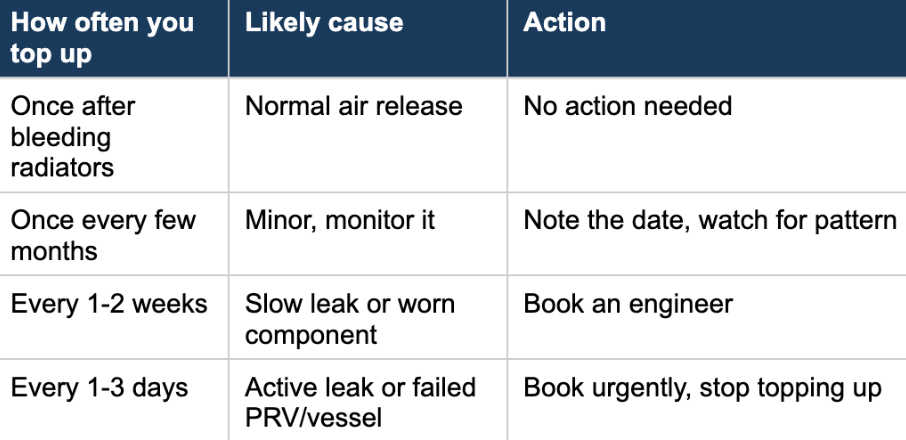
Ignoring recurring pressure loss leads to 3 problems: water damage from undetected leaks, increased strain on the boiler’s internal components, and higher energy bills from a system running below optimal pressure. A boiler running at 0.5 bar uses more gas to produce the same heat as one running at 1.2 bar. Annual servicing catches pressure-related faults early, before they turn into emergency repairs.
Frequently asked questions
Is it normal for a boiler to lose pressure?
A small, occasional pressure drop is normal, especially after bleeding radiators or a long period without use. Regular pressure loss every week or more often indicates a fault. The system is sealed, so water should not escape under normal operating conditions.
How do I fix my boiler that keeps losing pressure?
Start by checking for visible leaks at radiator valves, pipe joints, and the external overflow pipe. Repressurise via the filling loop to 1.2 bar. If pressure drops again within 48 hours, the cause is internal and needs a Gas Safe registered engineer to diagnose.
Why does my boiler lose pressure when the heating is off?
Pressure loss when the heating is off points to a leak or a faulty filling loop. The system is not generating pressure changes from heating water, so any drop comes from water leaving the system. Check the overflow pipe outside and the filling loop valves under the boiler.
Can a boiler lose pressure without a leak?
Yes. A failed expansion vessel causes pressure to spike when hot and drop when cold, without any water leaving the system. Trapped air pockets from unbled radiators can also cause gauge readings to fluctuate. Both need professional diagnosis to confirm.
Need a Gas Safe registered engineer to diagnose your pressure loss? Book a boiler repair in Edinburgh