


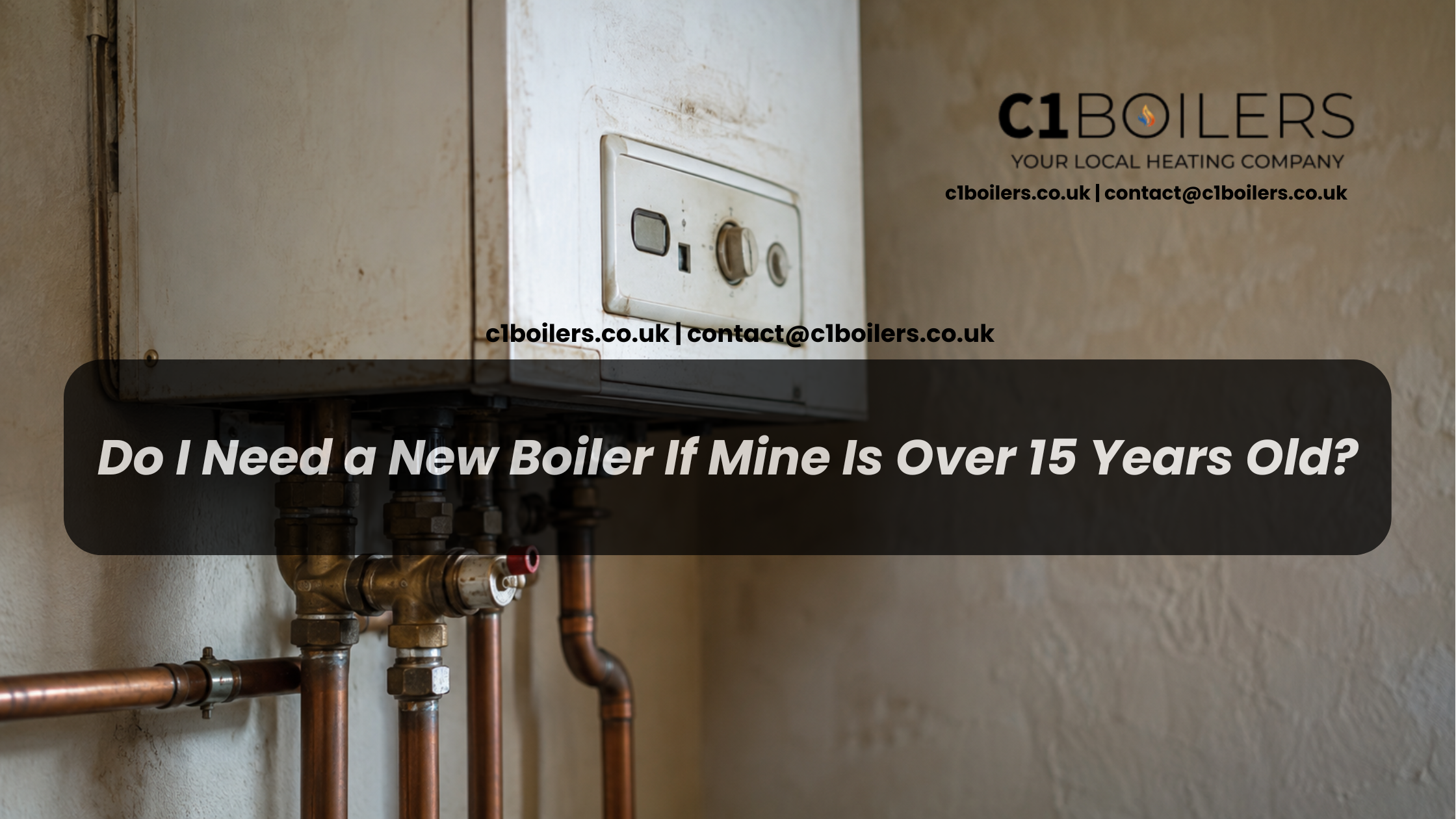
Your boiler is 15 years old. It still runs, but it has become noisier. The last service found a worn part. A neighbour tells you to replace it before winter. An online quote tool says the same thing before anyone has looked at the system.
Age matters. It is not the whole decision.
A 15-year-old boiler that has been serviced, remains reliable and has available parts does not automatically need replacing today. A 12-year-old boiler that breaks down repeatedly, costs more to repair and no longer suits the home may already be ready for replacement.
The sensible decision comes from five factors: condition, repair history, parts, performance and the likely cost of keeping it.
The Direct Answer
Consider replacement when a boiler over 15 years old has one or more of these problems:
- · Two or more faults in a relatively short period.
- · A major repair that is poor value against replacement.
- · Important parts that are obsolete or difficult to obtain.
- · Unreliable heating or hot water.
- · A poor service history.
- · A system that no longer matches the property.
- · Visible corrosion or recurring leaks.
- · Controls that cannot provide reasonable comfort or efficiency.
- · A flue or installation arrangement that needs substantial remedial work.
Consider continued use when:
- · It passes a proper annual service.
- · It has been reliable.
- · Parts remain available.
- · The repair required is modest and isolated.
- · Heating and hot-water performance meet the household’s needs.
- · There is no safety concern.
- · Replacement would provide little practical benefit at present.
The decision should follow an engineer’s diagnosis, not age alone.

How Long Should A Boiler Last?
Modern gas boilers commonly last around 10 to 15 years with appropriate installation, use and maintenance. Some continue well beyond that. Others fail earlier.
Connor, a C1 Boilers engineer, said: “Some boilers can last 20 to 30 years, but the typical lifespan for newer high-efficiency appliances is around 10 to 15 years.”
Older boilers sometimes appear more durable because they are mechanically simpler. That does not mean they are always economical to keep. They may use more gas, have fewer control options and rely on parts that become harder to source.
Newer boilers contain more electronics and compact components. Correct installation, clean system water and annual servicing matter.
A lifespan is a planning range, not an expiry date.
The repair-cost question
Homeowners often want a single number: at what repair cost should I replace the boiler?
There is no universal figure because a £300 repair means different things on a seven-year-old boiler and a 17-year-old boiler.
Connor said: “If the boiler is between 10 and 15 years old and the repairs are more than £250, replacing it is often advised.”
Use that as an engineer’s practical warning point, then look at the full picture.
Ask:
- What part has failed?
- Is this a one-off fault or part of a pattern?
- Are other expensive components showing wear?
- How long is the repair guaranteed?
- Is the part new, refurbished or obsolete stock?
- Does the boiler have a strong service history?
- Would replacement solve another problem, such as poor hot-water performance?
- What is the complete installed replacement price?
A repair can be technically possible but financially weak.
The difference between a minor repair and a major repair
A minor repair might involve a sensor, seal, valve component or control issue that can be resolved without suggesting broader deterioration.
A major repair may involve the heat exchanger, fan, gas valve, printed circuit board or several components at once. The exact cost depends on the model and availability.
The failed part is not the only concern. An older boiler can receive an expensive new component and then develop a separate fault months later.
That does not mean every major repair should be rejected. It means the engineer should explain the likely remaining condition rather than quote one part in isolation.
Repair frequency matters more than one breakdown
One breakdown after years of reliable operation can be reasonable maintenance.
Repeated visits are different. The household pays call-out charges, parts and labour, but it also absorbs the disruption of lost heating and hot water.
Keep a simple record:
- · Service dates.
- · Fault codes.
- · Parts replaced.
- · Repair totals.
- · Time without heating.
- Any changes in noise, pressure or hot-water delivery.
The pattern becomes clearer when it is written down.
If the boiler needed a repair last winter, another in spring and a third before the next heating season, replacement is no longer only about efficiency. It is about reliability.
Parts availability can make the decision for you
Manufacturers do not support every model forever. Components become obsolete, suppliers stop stocking them and refurbished parts may be the only option.
A repair quote can also be delayed while the engineer searches for a compatible component. That matters during cold weather.
Before approving an expensive repair, ask whether the part is readily available and whether other key parts for the model are still supported.
A boiler can be safe and functional today but approaching the point where one unavailable component ends its useful life.
Does An Old Boiler Always Cost More To Run?
Not always in a simple, predictable way.
A modern condensing boiler can operate efficiently when it is correctly sized, commissioned and controlled. An older non-condensing or poorly controlled system can waste more heat.
But the saving from replacement varies with:
- · Current boiler efficiency.
- · Gas use.
- · Property heat loss.
- · Thermostat and control habits.
- · Flow temperature.
- · Radiator sizing.
- · Hot-water use.
- · The efficiency of the new installation.
Do not accept a guaranteed annual saving without a proper basis.
Replacement may reduce consumption, but it should also improve reliability, control and suitability. Those benefits can be more valuable than a marketing estimate.
Edinburgh Property Type Changes The Answer
Tenement flats
Many Edinburgh tenements have compact heating systems but unusual flue and pipe routes. If an old boiler occupies an internal kitchen or cupboard, replacement may require a different flue solution.
A smaller flat may not need a high-output boiler for heating. The hot-water requirement and mains flow still need assessment.
Victorian and Edwardian terraces
Older terraces can have high heat loss, large radiators, gravity-fed hot water and altered pipework.
Replacing the boiler without assessing the rest of the system may repeat the original problem. A survey should consider whether the radiator output, controls and pipework suit modern lower-temperature operation.
Post-war semis
Many are suitable for straightforward replacement, but pipework under concrete floors can complicate leaks or alterations.
Extended family homes
A boiler chosen 15 years ago may no longer suit a home with an extension, loft conversion, extra bathroom or larger household.
Replacement is an opportunity to recalculate demand. Do not automatically install the modern version of the old boiler.
Safety comes before the financial calculation
A boiler should be serviced and worked on by a suitably qualified Gas Safe registered engineer.
If an engineer identifies an unsafe appliance, flue problem, combustion issue or gas leak, the decision is no longer a normal repair-versus-replacement comparison. Follow the safety advice.
Do not remove the boiler casing, adjust gas components or continue resetting an appliance that repeatedly locks out without diagnosis.
A carbon monoxide alarm is an important safety measure, but it does not replace servicing or professional checks.
What annual servicing can tell you
A useful service is not only a stamp for the warranty.
The engineer can identify:
- · Signs of leakage or corrosion.
- · Combustion and flue concerns.
- · Deteriorated seals.
- · Pressure problems.
- · Blocked or dirty components where inspection permits.
- · Control issues.
- · Early signs of a component failing.
- · Whether the installation still meets current expectations.
Servicing cannot guarantee that a 15-year-old boiler will not fail. It gives a better basis for planning.
If the engineer says, “This is running well, but this part is showing wear and may be difficult to source,” you can plan replacement before an emergency.
Replace Before Winter Or Wait Until It Fails?
Waiting can appear economical. It avoids spending money while the boiler still works.
The risk is timing. A failure in January creates urgency. Installer availability is tighter. The household has less time to compare systems and quotes. A repair may be approved simply to restore heat, even when replacement was already likely.
Planned replacement gives time to:
- · Compare boiler types.
- · Test mains flow.
- · assess heat loss.
- · Check flue options.
- · Choose controls.
- · Review finance.
- · Schedule work around the household.
- · Understand warranty conditions.
If the boiler is old but stable, spring or summer can be a sensible time to assess options without pressure.
When repair still makes sense
Repair may be sensible when:
- · The diagnosis is clear.
- · The part is available.
- · The rest of the boiler is in good condition.
- · The repair cost is proportionate.
- · The appliance has not been failing repeatedly.
- · Replacement is being planned but cannot happen immediately.
- · The existing boiler remains suitable for the home.
Ask the engineer for an honest view of both options. C1 Boilers customer reviews repeatedly mention engineers explaining choices and not pushing an unnecessary replacement. That is the right behaviour for this decision.
When replacement is usually the better decision
Replacement becomes more convincing when several issues appear together:
- · Boiler age above 15 years.
- · Repeated breakdowns.
- · Repair above the practical value of the appliance.
- · Poor parts support.
- · Unsuitable hot-water performance.
- · Significant corrosion.
- · High gas use compared with similar periods.
- · Old controls.
- · A planned property alteration.
- · A desire to remove a cylinder or, in the opposite direction, support more bathrooms.
A replacement should solve the current fault and improve the overall system.
What to ask in a replacement survey
- What boiler type suits the household?
- What is the calculated heating demand?
- What is the measured mains flow?
- Are the radiators suitable?
- Does the gas pipe need upgrading?
- Can the boiler stay in the same position?
- What cleaning and filter are included?
- What controls are recommended?
- What guarantee is available and what keeps it valid?
- What is the full installed cost, including VAT and paperwork?
Do not let the age of the old boiler rush the specification of the new one.
Frequently Asked Questions
Should I replace a boiler that is 15 years old but still works?
Not automatically. Arrange a service and condition assessment. Replacement is more urgent when reliability, parts availability, performance or repair cost is becoming a problem.
Is a 20-year-old boiler dangerous?
Age alone does not prove danger, but an older boiler needs competent inspection and regular servicing. Any safety concern should be addressed immediately by a Gas Safe registered engineer.
Is it worth repairing a 15-year-old combi boiler?
It can be, when the fault is minor, the part is available and the boiler has otherwise been reliable. A high repair cost or repeated faults makes replacement more sensible.
Will a new boiler lower my bills?
It may, particularly when replacing an inefficient appliance and improving controls. The amount depends on the property, gas use and quality of the new system. Avoid guaranteed saving claims without evidence.
How can I avoid an emergency replacement?
Service the boiler annually, keep repair records and request a replacement survey before winter if faults are increasing or parts are becoming difficult to find.
Get An Honest Repair-or-Replace Assessment in Edinburgh
A boiler over 15 years old deserves a plan, not an automatic sales pitch.
C1 Boilers provides boiler repair, servicing and replacement across Edinburgh, Musselburgh and the Lothians. An engineer can diagnose the current fault, explain whether repair is proportionate and survey the home for replacement when that is the stronger long-term decision.