



We are based on Craighall Avenue in Musselburgh. When we take on an apprentice, we bring them on jobs across East Lothian from day one. The only way to understand these properties is to be inside them. The Victorian terraces on Musselburgh High Street. The 1930s semis in Tranent. The stone cottages in Pencaitland. They all heat differently and they all make different demands on a boiler.
This guide covers the specific heating challenges older properties in Musselburgh and East Lothian present, and what to consider before replacing or upgrading your system.
Why Older Properties in Musselburgh and East Lothian Are Different
East Lothian’s housing stock spans centuries. The heating demands of each era are distinct, and the wrong boiler choice for the wrong property type wastes money from day one.
Musselburgh town centre. Victorian and Edwardian stone-built terraces and townhouses line the High Street, North High Street, and Inveresk Road. Solid stone walls up to 600mm thick. High ceilings. Original single-glazed sash windows in many properties. These homes lose heat faster than modern builds and need a boiler with enough output to compensate.
Tranent and Prestonpans. Pre-war and post-war semi-detached houses built between the 1920s and 1950s. Cavity walls, but often without insulation. Smaller rooms but still with original pipework running under concrete floors. Accessing and replacing pipework in these properties adds complexity and cost to any boiler installation.
East Lothian village cottages. Haddington, Pencaitland, Gifford, East Linton. Older stone cottages with thick walls, low ceilings, and compact layouts. Many still have gravity-fed hot water systems with cold water tanks in the loft and hot water cylinders in upstairs cupboards. Some still have back boilers connected to open fires.
Newer estates. Wallyford, Whitecraig, and the new-build developments on the edges of Musselburgh and Tranent. These properties have modern insulation, sealed heating systems, and boilers under 10 years old. The heating challenges here are minimal by comparison.
Older properties usually have higher heat loss, so boiler output and emitter sizing need more careful calculation. Some older homes have had excellent retrofit insulation and perform well. Others have not. The only way to know is a proper site survey, not a quick quote over the phone.
The Heating Challenges Specific to Pre-1960s Properties
Older properties in East Lothian share a set of heating problems that newer homes do not have. Understanding these before choosing a boiler saves you from expensive mistakes after installation.
- Undersized original radiators. Many pre-1960s properties still have their original cast iron or early pressed steel radiators. These were sized for the heating systems of their era, not for modern condensing boilers. They are often too small to heat the room efficiently, especially in high-ceilinged Victorian properties. A new boiler connected to undersized radiators will cycle on and off too frequently, reducing efficiency and shortening the boiler’s lifespan. If you want the boiler to condense efficiently at lower flow temperatures, which is where the real efficiency gains and bill savings come from, you will likely need larger or additional radiators. This also makes the property easier to transition to a heat pump or low-carbon system in the future.
- Gravity-fed hot water systems. A gravity-fed system relies on a cold water tank in the loft and a hot water cylinder, using gravity to move water through the system. Water pressure is low, heating is slow, and the system takes up significant space. Converting from gravity-fed to a modern sealed system is one of the most common upgrades we carry out in East Lothian, but it requires careful assessment of existing pipework before committing. Be prepared for some disruption: moving from gravity to mains pressure in older Scottish properties can involve lifting floors to access pipework, boxing-in new pipe runs, and a fair amount of decoration making-good afterwards. It is worth knowing this upfront so the scope of work does not come as a surprise.
- Poor insulation. Solid stone walls cannot take standard cavity wall insulation. Many East Lothian homeowners face a choice between expensive internal wall insulation or accepting higher heat loss and sizing their boiler accordingly. Loft insulation is often inadequate in older properties. Without addressing insulation first, a new boiler compensates for the building’s shortcomings rather than operating at peak efficiency.
- Original copper pipework. Pipework in pre-1960s properties has been carrying heating water for decades. Corrosion builds up inside the pipes, restricting flow and contaminating the system with magnetite sludge. In many East Lothian jobs, we find that sections of original pipework need replacing or the entire system needs a power flush before a new boiler can be connected safely.
Combi Boiler vs System Boiler: Which Is Better for Older East Lothian Homes?
The honest answer: it depends on the property. A combi boiler is not always the right choice for an older home, even though it is the most popular boiler type in the UK. Here are the real trade-offs.
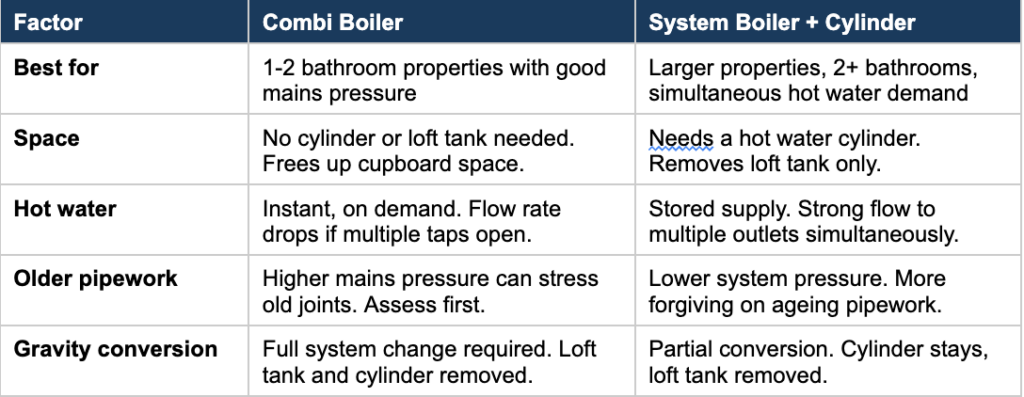
For a two-bedroom Victorian flat on Musselburgh High Street with one bathroom and good mains pressure, a combi boiler is usually the right call. It saves space and delivers efficient hot water on demand.
For a four-bedroom stone cottage in Pencaitland with two bathrooms, a family of four, and original pipework under the floors, a system boiler with a hot water cylinder is the safer choice. It handles simultaneous demand without pressure drops and puts less stress on old pipe joints.
The wrong choice in either direction costs you. A combi boiler in a large property with multiple bathrooms will underperform. A system boiler in a small flat takes up space you do not need to sacrifice. The right answer comes from a proper site survey, not a brochure.
Whichever type you choose, any new boiler fitted to an older system should include a magnetic filter, a chemical inhibitor, and where appropriate an inline scale reducer. These protect the new heat exchanger from the corrosion debris and contaminants already present in ageing pipework. This applies to combi and system boilers equally.
Real Installations: What We Have Fitted in Musselburgh and East Lothian
These are anonymised examples from actual C1 Boilers jobs in the area. No invented case studies. No stock photos. Real properties, real decisions, real outcomes. You can read verified customer reviews of our work at trustpilot.com
Victorian terrace, Musselburgh High Street. Three-bedroom stone-built terrace with one bathroom. Original gravity-fed system with a cold water tank in the loft and a hot water cylinder in the upstairs cupboard. We removed the loft tank and cylinder, installed a Worcester Bosch Greenstar combi boiler in the kitchen, power flushed the existing pipework, and fitted a magnetic filter. The homeowner gained a full cupboard back and reported noticeably faster hot water response. Total install time: one day.
1930s semi-detached, Tranent. Four-bedroom property with two bathrooms. The existing boiler was a 20-year-old system boiler with a vented cylinder. Pipework ran under a concrete ground floor. We replaced the boiler and cylinder but kept the existing pipework in place after a successful power flush. Replaced three undersized radiators in the bedrooms. We recommended a system boiler over a combi because of the two bathrooms and the family’s simultaneous hot water demand. Total install time: two days.
Stone cottage, Pencaitland. Two-bedroom cottage with solid stone walls and single-glazed windows. The existing back boiler had been disconnected years earlier and replaced with an electric heating system. We installed a new gas supply, fitted an Ideal Vogue Max combi boiler, and ran new pipework to six radiators. The stone walls required core drilling for the flue. The owner moved from electric to gas and saw a noticeable drop in bills compared with their previous usage. Actual savings depend on tariffs and how the system is used. Total install time: three days including gas supply work.
Frequently Asked Questions
What boiler is best for an old house?
It depends on the property size, number of bathrooms, and hot water demand. A combi boiler suits smaller older homes with one bathroom. A system boiler with a hot water cylinder is better for larger properties with two or more bathrooms and simultaneous demand.
Can I install a combi boiler in an older property?
Yes, provided your mains water pressure is adequate and the existing pipework can handle the conversion from gravity-fed to mains-fed. A site survey will confirm whether your property is suitable. Some older pipework may need partial replacement.
How much does it cost to heat an older property in Scotland?
As a rule of thumb, it is common for older Scottish properties to cost 20 to 40% more to heat than similar-sized modern builds, depending on insulation levels and airtightness. Upgrading the boiler, adding insulation, and fitting correctly sized radiators are the three most effective ways to bring running costs down.
What is the best heating system for a Victorian house?
A modern condensing boiler (combi or system depending on size) paired with correctly sized radiators and a magnetic filter gives the best balance of efficiency and performance. Addressing insulation and draughts alongside the boiler upgrade maximises the return on investment. Getting radiator sizing and insulation right now also makes it easier to transition to a low-carbon system like a heat pump or district heating later, even if you are sticking with gas for the moment.